BitView
BitView
00-99 Redstone Display in Minecraft – Boolean logic meets creative engineering.










BitView is a fully functional two‑digit decimal display built inside Minecraft using pure redstone logic.
It demonstrates the practical application of Boolean algebra, Karnaugh maps, and logic minimization on a highly constrained hardware platform (redstone torches and dust).
📄 Abstract
BitView presents a two‑digit decimal display (00–99) implemented in Minecraft redstone as a case study in combinational logic design. Using truth tables, Karnaugh maps, and Boolean minimization, the circuit reduces gate count by approximately 73.07% compared to an unoptimized baseline. The design uses only NOT and OR gates (the only primitives available in redstone) via De Morgan transformations.
🚀 Quick Navigation
- Getting Started
- Key Features
- Gallery
- Video Demo
- Repository Structure
- How It Works
- Quantitative Results
- Why Only NOT and OR?
- Project Evolution
- Hexadecimal Extension
- Legacy Attempts vs Final
- Credits
📦 Getting Started
Requirements
- Minecraft: Java Edition (version 1.20.4 or newer, but 1.20+ should work)
- No mods or datapacks required – pure vanilla.
How to Install the World
- Download or clone this repository.
- Copy the folder
00-99_Display/world/BitView_00-99_Displayinto your Minecraftsavesdirectory:- Windows:
%APPDATA%\.minecraft\saves - macOS:
~/Library/Application Support/minecraft/saves - Linux:
~/.minecraft/saves
- Windows:
- Launch Minecraft, select the world BitView – 00-99 Display, and enter.
How to Use the Display
The physical structure is organised in vertical layers:
- Bottom layer → units digit circuit
- Layer above → tens digit circuit
- (Higher layers could be added for hundreds, thousands, etc.)
The displays are placed side by side (tens on the left, units on the right) to form a normal two‑digit number.
The keypad consists of two 3×3 lever blocks (digits 1–9), stacked vertically:
- Bottom 3×3 block → selects the units digit (1–9)
- Upper 3×3 block → selects the tens digit (1–9)
How to compose a number:
- Tens digit – pull any lever in the upper 3×3 block (1–9).
- Units digit – pull any lever in the lower 3×3 block (1–9).
- Zero is the default state – to display 0 in a digit, leave all levers in that block untouched.
- Pull any combination to display a number from 00 to 99.
Example:
-
To show 53:
Pull lever5in the upper (tens) block.
Pull lever3in the lower (units) block.
The left display shows5, the right display shows3. -
To show 7 (as
07):
Pull lever7in the lower (units) block.
Leave the upper (tens) block untouched → left display shows0.
✨ Key Features
- Displays numbers from 00 to 99 on two side‑by‑side 7‑segment displays.
- Input via 18 levers (1–9 for units, 1–9 for tens). Zero is the default state.
- Each digit is driven by an identical circuit derived from minimized Boolean expressions (obtained via Karnaugh maps).
- Logic implemented using only NOT and OR gates (the only reliable gates in redstone) via De Morgan transformations.
- The entire circuit is stacked vertically to keep the world compact and readable.
- Fully documented with truth tables, K‑maps, logic diagrams, and conversion to NOT/OR.
🖼️ Gallery
| Encoder part | Main circuit | Display example: 51 |
|---|---|---|
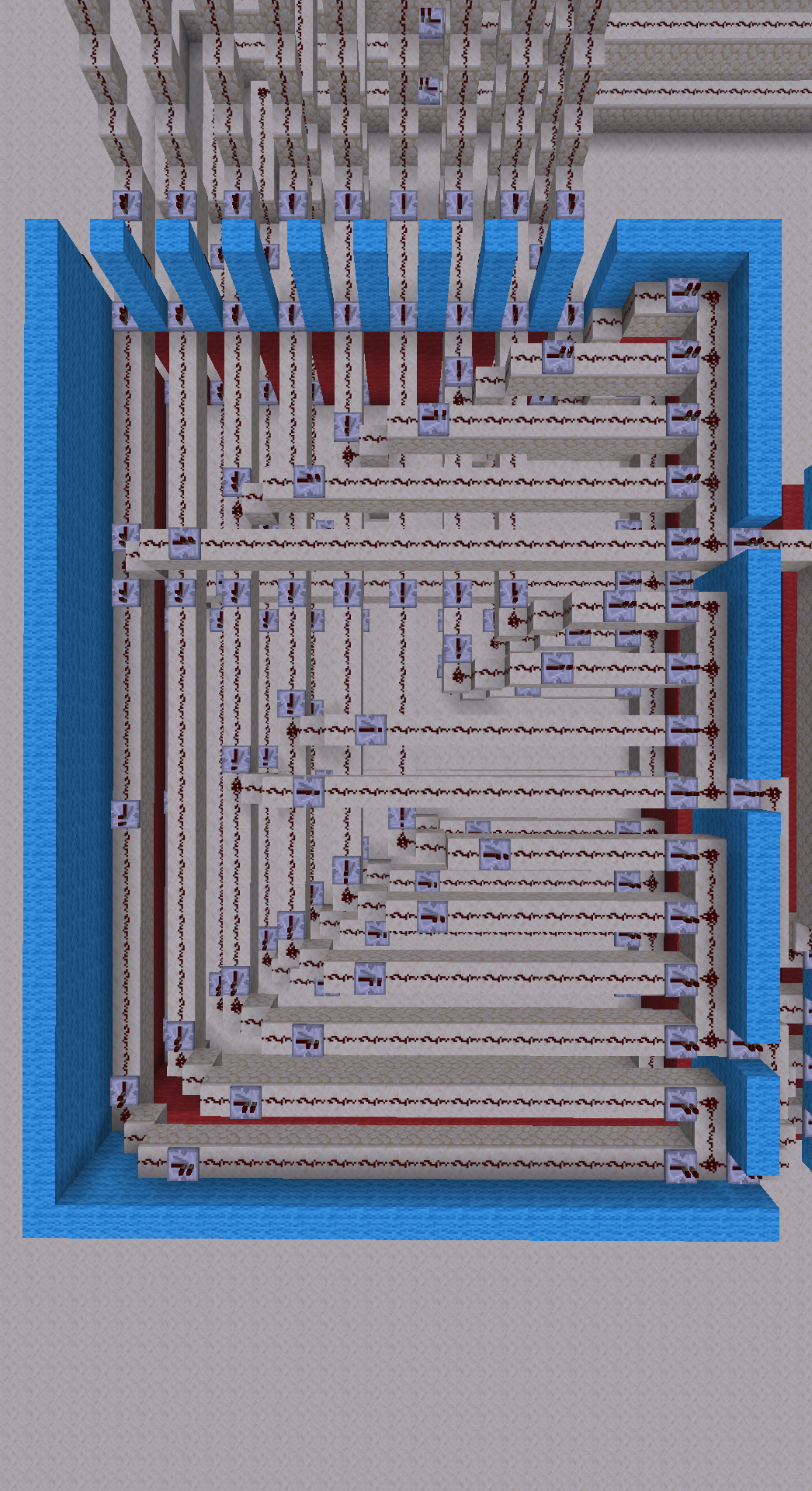 |
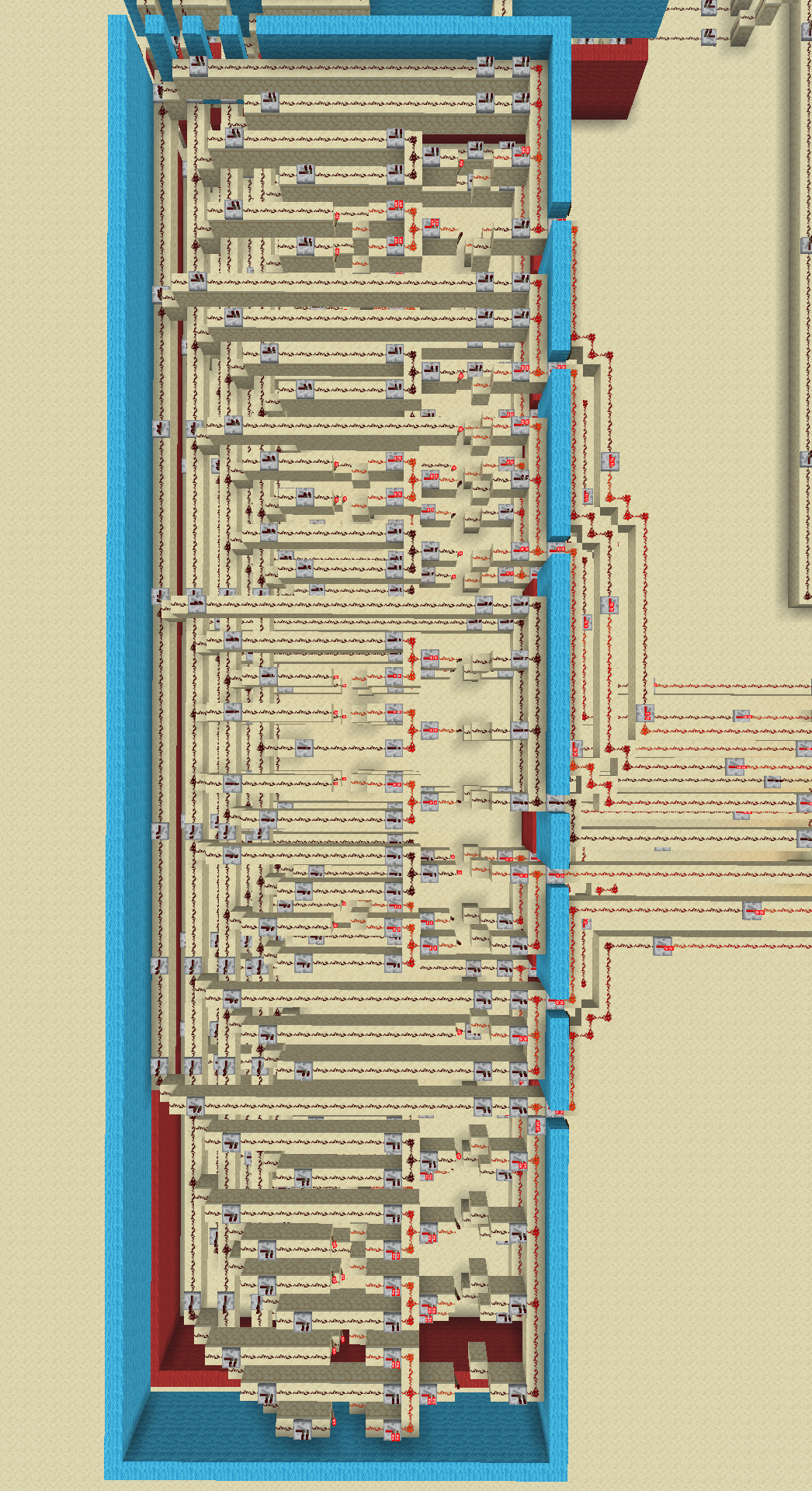 |
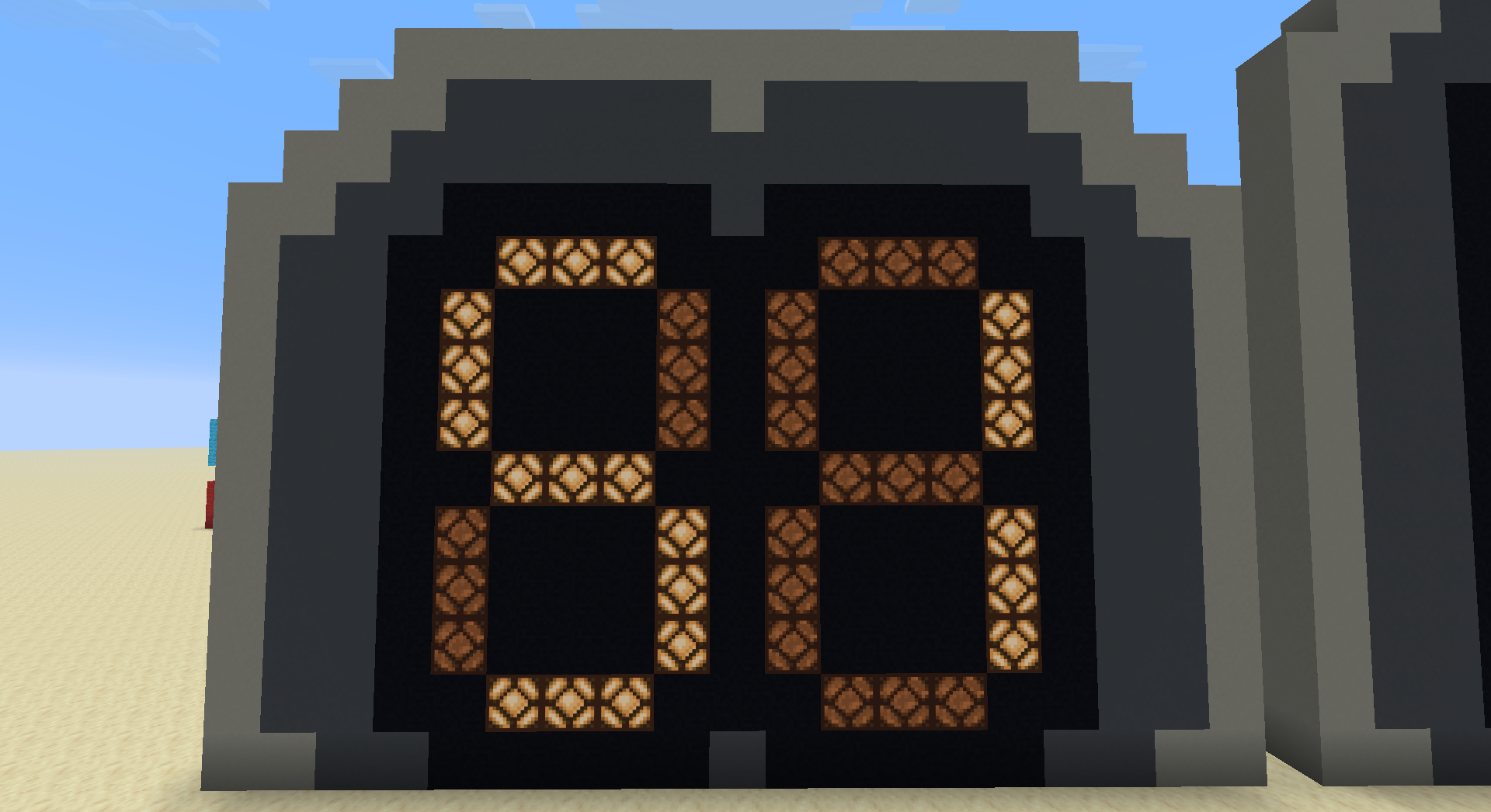 |
| Display: 92 | Display: 99 | Full overview |
|---|---|---|
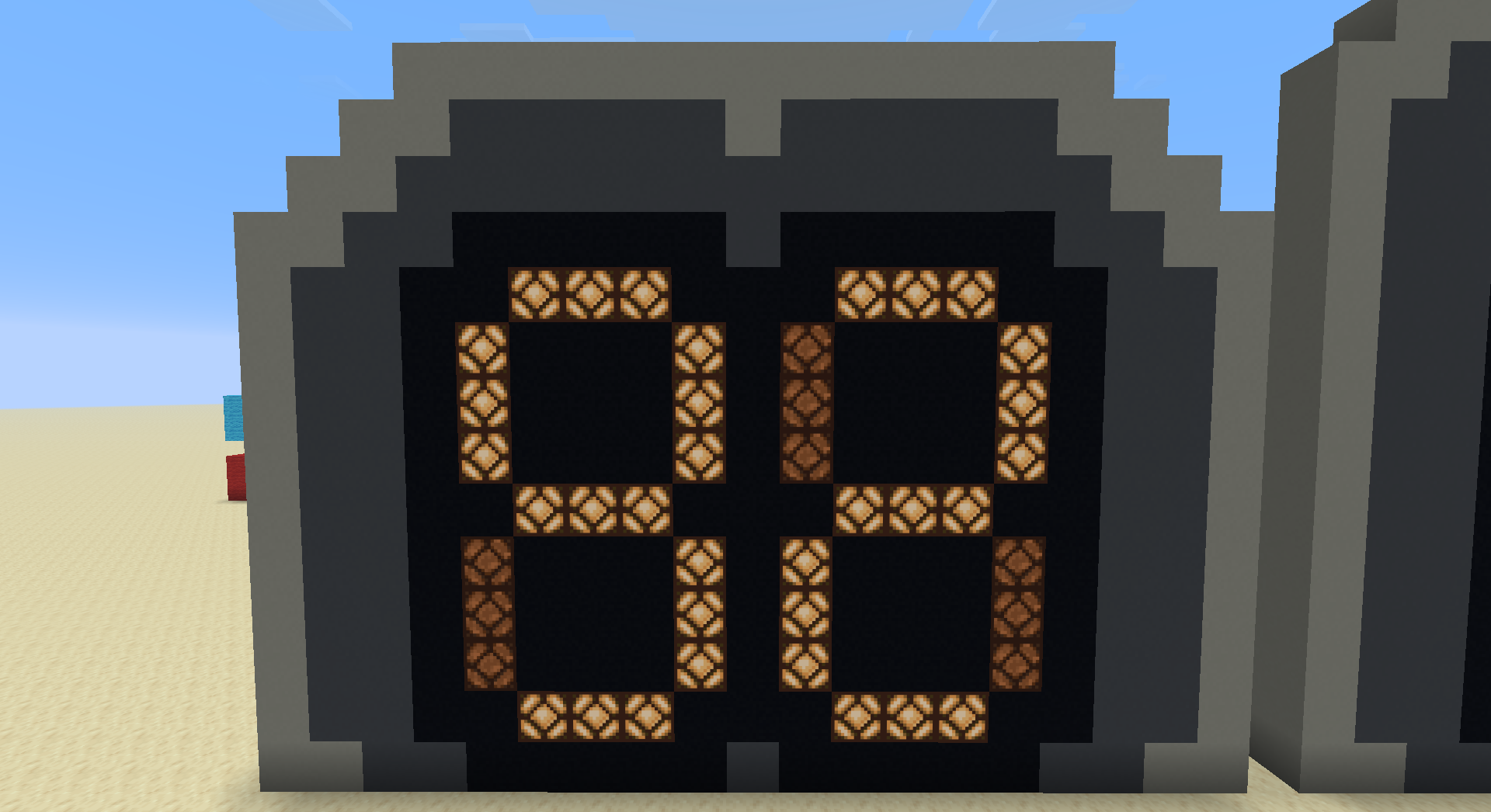 |
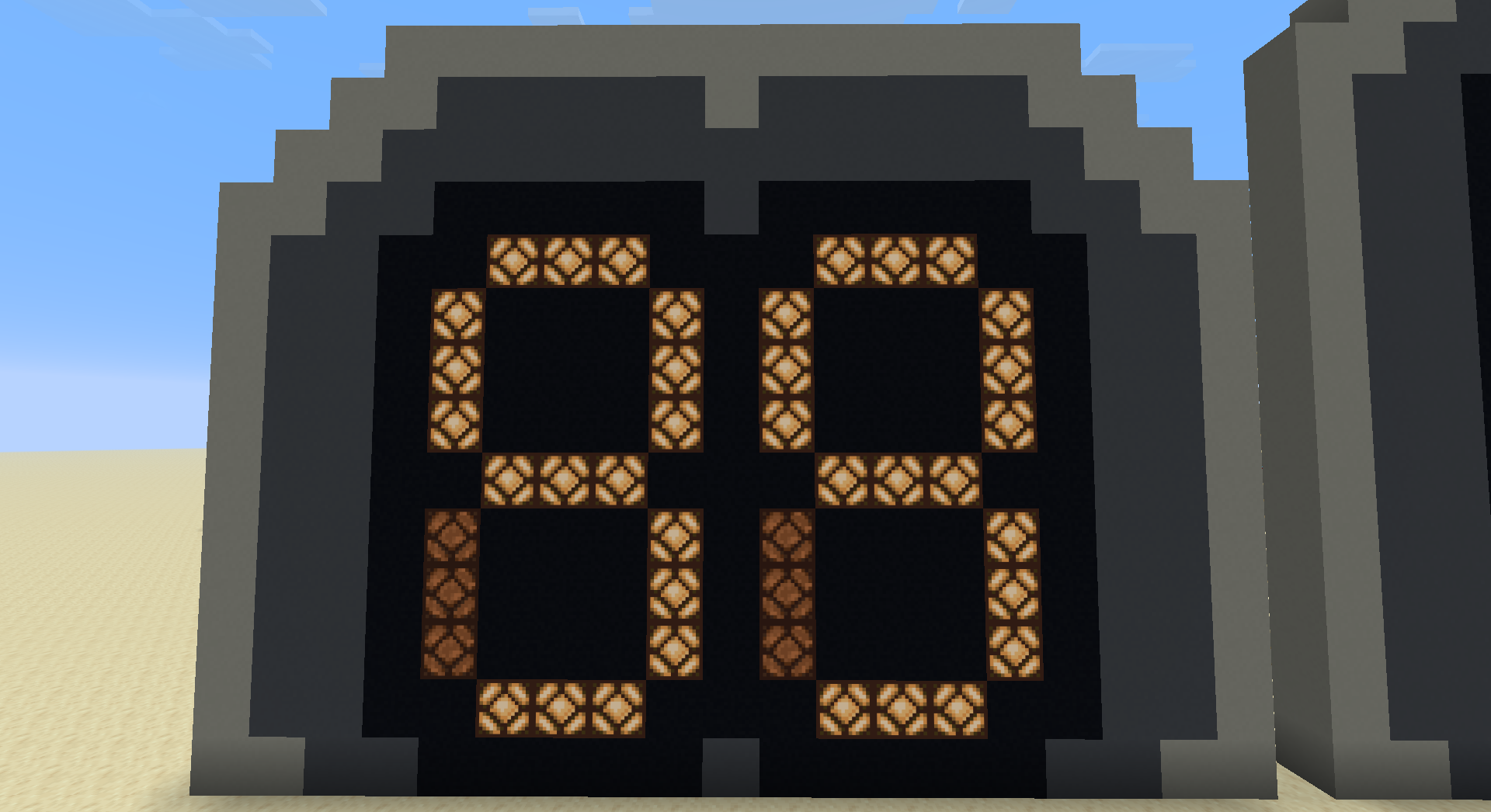 |
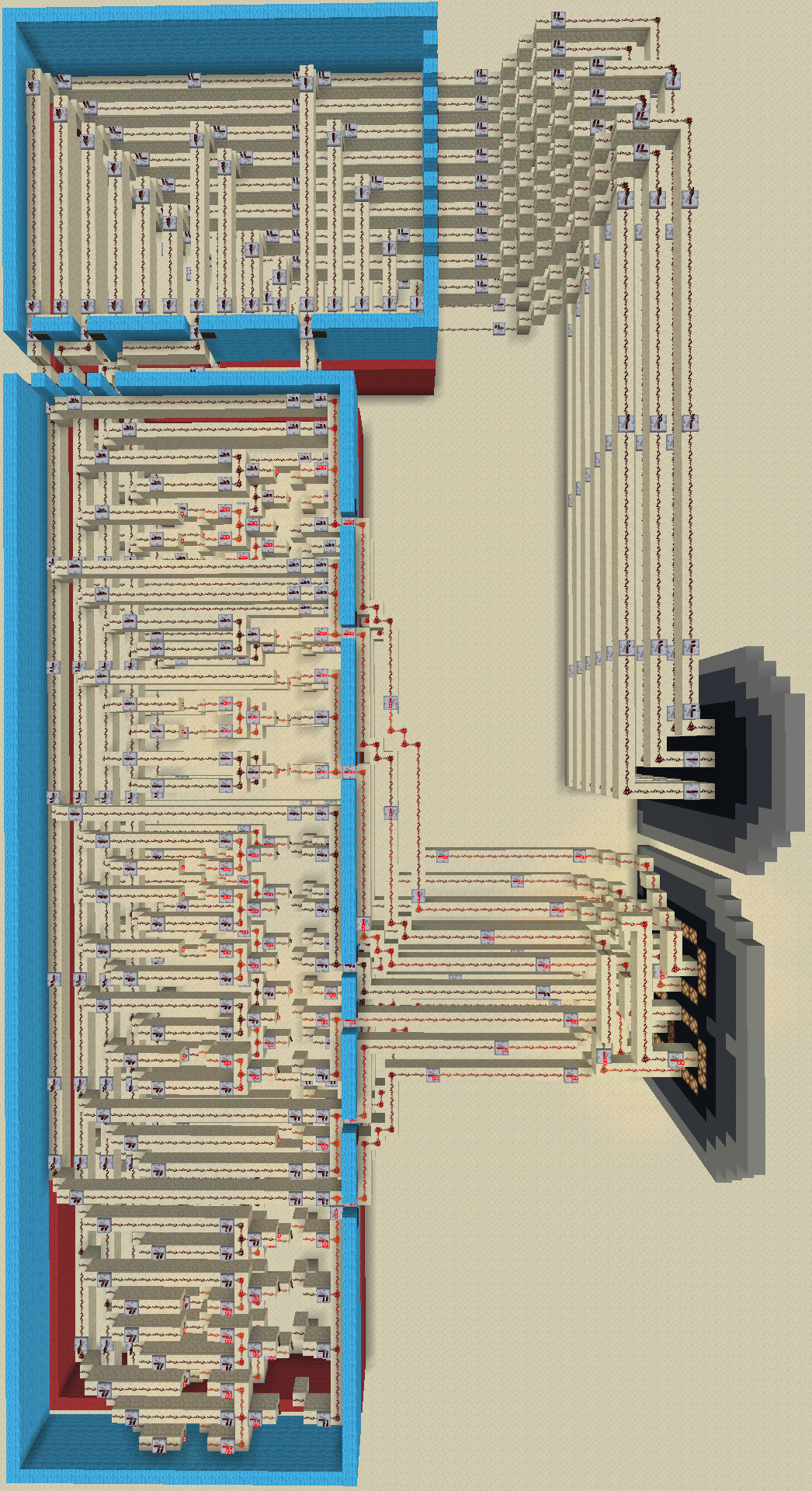 |
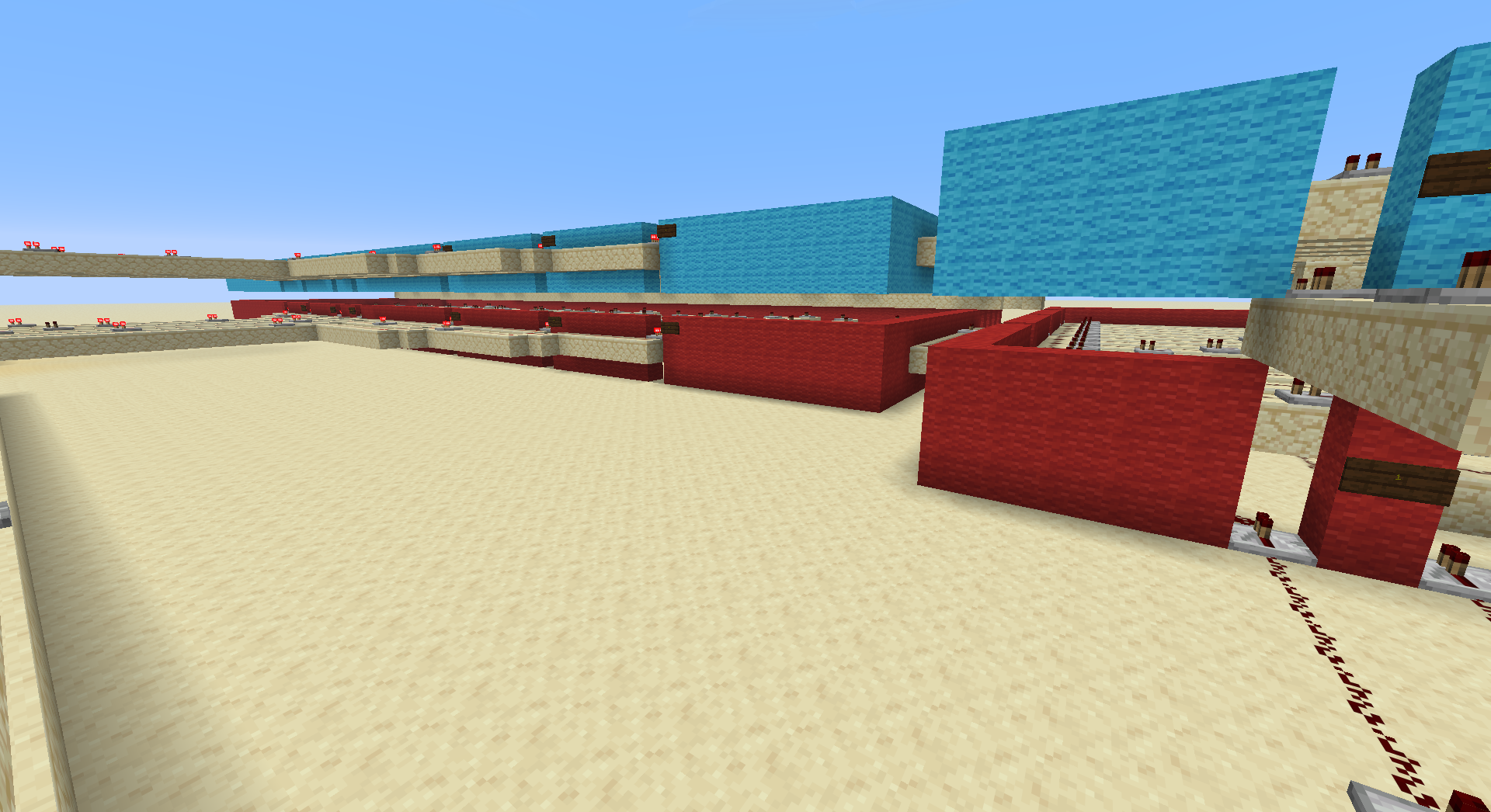
More screenshots can be found in the 00-99_Display/screenshots folder.
Vertical layering (isometric view)
 Units circuit at the bottom, tens circuit stacked above. Displays are side‑by‑side.
🎥 Video Demo
A short demonstration of the display in action:
record test.mp4 (download to watch)
📁 Repository Structure
BitView/
├── .github/workflows/            # CI/CD (build.yml)
├── 00-99_Display/                # Main project
│   ├── circuit docs/             # Truth table, K‑maps, logic diagrams, AND to NOT/OR
│   ├── encoder docs/             # Encoder schematics (1‑to‑9)
│   ├── screenshots/              # In‑game screenshots
│   ├── video/                    # Demo video
│   └── world/                    # Minecraft save folder
├── legacy_attempts/              # Earlier unoptimized versions
│   ├── first_attempt_single_display/
│   ├── second_attempt_double_display/
│   └── hexadecimal_circuit/      # Theoretical hexadecimal decoder
├── docs/                         # Static documentation (PDFs, images for future Pages)
├── .gitignore
├── ARCHITECTURE.md
├── CHANGELOG.md
├── CONTRIBUTING.md
├── LICENSE
└── README.md
👉 Explore the folders directly from this repository.
⚙️ How It Works
- Input encoding – Each lever directly selects a decimal digit (no binary conversion on the lever side).
- Binary‑coded decimal (BCD) – The lever signals are encoded into 4‑bit BCD inside the circuit.
- Karnaugh maps – For each of the 7 segments (a–g), a truth table for inputs 0–9 was built.
- Minimization – K‑maps produced minimal AND‑OR expressions.
- NOT/OR conversion – Using De Morgan’s law, all AND gates were replaced by NOT‑OR combinations (the only primitives available in redstone).
- Vertical stacking – The whole circuit for one digit was replicated above itself to drive the tens digit.
- Redstone implementation – Torches (NOT) and dust (OR) implement the final logic.
The “Default‑On” Challenge
Redstone torches are on by default. This means the circuit tends to light segments when no input is active. To display 0 correctly, we designed the logic so that with no lever pulled, the segments that form a “0” light up. There is no “all‑off” state – 0 is the intended default.
📊 Quantitative Results
The following metrics compare the final optimised circuit against the unoptimised double‑digit legacy version. All measurements are approximate and based on redstone component counts (torches = NOT gates, dust lines = OR gates).
| Metric | Unoptimised | Optimised (final) | Improvement |
|---|---|---|---|
| Total NOT gates (torches) | 125 | 28 | 77.6% |
| Total OR gates (dust lines) | 57 | 21 | 63.15% |
The application of established metrics such as logical effort was precluded by the hybrid nature of Minecraft’s redstone system, which operates concurrently as a logic circuit in certain aspects and as an electrical circuit in others. Consequently, the “Default-On” phenomenon would have rendered any assessment based on logical effort inherently unfeasible, thereby justifying the exclusion of such methodology from our evaluation framework.
🔌 Why Only NOT and OR?
Minecraft redstone provides two basic logic components:
- Redstone torch → NOT gate (output ON when input OFF).
- Redstone dust → OR gate (output ON if any input is ON).
AND gates are simulated using De Morgan’s law:
A AND B = NOT( (NOT A) OR (NOT B) )
All expressions in this project were converted to this NOT‑OR form. See 00-99_Display/circuit docs/AND to OR-NOT.md for a detailed explanation.
📈 Project Evolution
This repository also contains two earlier (unoptimized) versions for comparison:
first_attempt_single_display– A single‑digit 0‑9 display with non‑minimized logic.second_attempt_double_display– A two‑digit 00‑99 display using the same unoptimized logic.
These show the iterative improvement process and the importance of Boolean minimization when working with redstone.
🔢 Hexadecimal Extension
The folder hexadecimal_circuit (inside legacy_attempts) contains a complete theoretical design for a hexadecimal encoder (0‑9, A‑F). It includes truth tables, Karnaugh maps, minimized expressions, and circuit schematics. The design is fully worked out but was not built in Minecraft due to the excessive wiring complexity in 3D.
📊 Legacy Attempts vs Final (Optimised)
| Version | Status | Minimisation | Redstone Size | Latency | Playable |
|---|---|---|---|---|---|
| Single digit 0‑9 (unoptimised) | Working | ❌ Incorrect (redundant implicants) | Large | High | ✅ |
| Double digit 00‑99 (unoptimised) | Working | ❌ Same as above | Very large (100‑lever keypad) | High | ✅ |
| Hexadecimal 0‑F (theoretical) | Paper only | ✅ Optimal + gate sharing | Not built (impossible to wire compactly) | N/A | ❌ |
| Final 00‑99 Display | Working | ✅ Correctly minimised | Compact (vertical stacking) | Low | ✅ |
The final version uses the same vertical layering as the second attempt but with correctly minimised Boolean expressions, resulting in fewer gates, shorter signal paths, and a much cleaner redstone layout.
📖 Full details and “rough” documentation of the legacy attempts are available in the
legacy_attempts/folder.
🛠️ Tools (Python scripts)
The tools/ folder contains utility scripts:
simulate_decoder.py– simulate the BCD to 7‑segment decoder for any digit 0‑9.validate_world.py– advanced validation of Minecraft world files (existence, non‑empty, region files).generate_truth_table.py– generate a;‑delimited CSV truth table from the minimised expressions (output:generated_truth_table.csv).
To run them, ensure Python 3 is installed and execute from the repository root:
cd tools
python simulate_decoder.py 5
python validate_world.py
python generate_truth_table.py
🙏 Credits
- Davide Ferigato – Project design, redstone implementation, documentation.
- Roberto Tittoto – Collaboration on the first Karnaugh maps (single‑digit unoptimised version).
- Thanks to the Minecraft redstone community for inspiration.